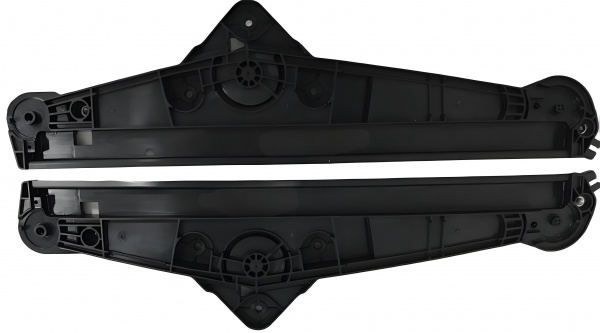
PP+LGF, or Long Glass Fiber Reinforced Polypropylene, is a high-performance material ideal for manufacturing automotive components such as window regulators.
It is produced by incorporating long glass fibers (LGF) into a polypropylene (PP) matrix. Compared to conventional short-glass-fiber reinforced materials, the key feature is the longer fiber length (typically 10–15 mm), which forms a three-dimensional network within the part, delivering a significant leap in performance.
CORE ADVANTAGES: WHY CHOOSE PP+LGF?
The main benefits of using PP+LGF in window regulator applications are:
1. Significant Weight Reduction – This is its most outstanding advantage. Compared to traditional steel structures, window regulators made with PP+LGF can reduce weight by approximately 30%. For example, products showcased by leading global supplier Brose save over 600 grams per door. This makes the weight comparable to aluminum, while the cost remains close to that of steel.
2. Superior Mechanical Properties – The long-fiber 'skeleton' structure provides outstanding strength, stiffness, and impact resistance. This enables the regulator to withstand frequent lifting/lowering operations and vibration shocks in daily use.
3. Excellent Dimensional Stability – The material exhibits low creep and low warpage, meaning it maintains shape and dimensional accuracy under long-term loads or temperature changes, ensuring smooth and reliable window movement.
4. High Integration Capability – PP+LGF allows multiple functional components (e.g., guide rails, sensor brackets, handle mounts) to be integrated into a single molded part through injection molding. This high level of integration not only simplifies assembly but also reduces installation time by up to 30%.
5. Superior Weather and Corrosion Resistance – The material is inherently corrosion-resistant, eliminating the need for additional anti-rust treatments. It also offers good heat-aging resistance, enabling long-term stable operation in high-temperature environments such as the engine compartment.
KEY PERFORMANCE DATA COMPARISON
The following data clearly demonstrate the significant advantages of long glass fiber (LGF) over short glass fiber (SGF):
- Tensile Strength: PP + 40% SGF gives 82–85 MPa, while PP + 40% LGF gives 118–124 MPa, which is about 40–50% higher.
- Notched Impact Strength: SGF gives 108–120 J/m, whereas LGF gives 228 J/m, about 90–110% higher.
- Flexural Modulus: SGF gives 6.5–6.9 GPa, while LGF gives 7.7–8.5 GPa, about 15–20% higher.
Source: RTP Company
INDUSTRY APPLICATION EXAMPLE
Brose, a global market leader in door systems, is a pioneer of this technology. As early as 2011, they introduced the world's first integrated window regulator made from long-glass-fiber reinforced polypropylene. This design not only achieved weight and cost savings but also met ISO recycling and reuse standards, offering a better ecological balance.
DESIGN CONSIDERATIONS
While PP+LGF offers excellent performance, the following points should be noted when replacing metal designs:
- Mold Design – The overall structure and thickness of critical areas may need adjustments to ensure sufficient part strength.
- Material Brittleness – The addition of glass fibers reduces toughness and increases brittleness, which must be taken into account during structural design.
SUMMARY
In summary, PP+LGF material, with its unique combination of lightweight, high performance, and high integration, has become one of the preferred materials for modern window regulator designs, perfectly balancing the demands of performance, cost, and environmental sustainability.
If you would like further details about its application in other automotive parts (e.g., front-end carriers, instrument panel skeletons) or specific grade selections, I am happy to provide more information.








 Baolaihua
 Customer service staff